
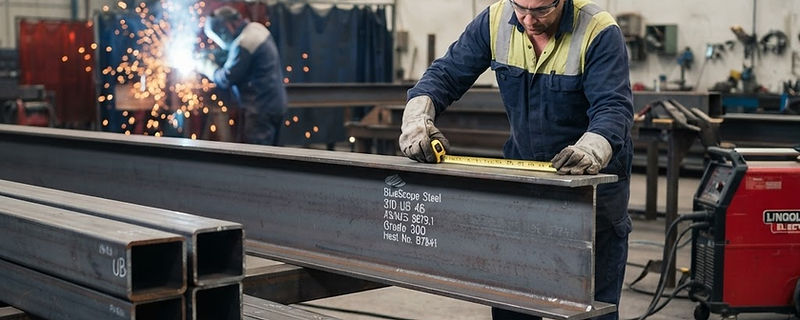
Why weight is the first number you need
Almost every downstream decision in a steel job depends on mass: crane and rigging selection, truck axle limits, temporary propping, weld consumable estimates and, of course, the invoice from the supplier. Getting the mass right at the estimating stage is the difference between a job that earns margin and one that quietly loses it.
The base relationship
Steel mass is volume multiplied by density. Carbon steel sits at 7850 kg/m³, which is the value used by Australian distributors when they publish mass per metre.
For a flat plate:
mass (kg) = width (m) × thickness (m) × length (m) × 7850
A 2400 × 1200 × 10 mm plate is therefore 2.4 × 1.2 × 0.010 × 7850 = 226 kg.
Hollow sections and pipe
For hollow sections, work out the actual steel area rather than the footprint:
area = B × H − (B − 2t) × (H − 2t)
For round pipe the same logic applies with diameters:
area = π/4 × (D² − (D − 2t)²)
Note that nominal bore is a label, not a dimension. DN100 pipe is 114.3 mm outside diameter. Always calculate from outside diameter and wall thickness.
Where estimates drift
- Mill tolerances. Plate thickness rolls slightly under nominal. A 10 mm plate at −0.5 mm is 5% lighter, and suppliers charge on theoretical mass.
- Cut wastage. Nesting losses of 5–12% are normal on plate work, more on curved profiles.
- Surface treatment. Hot dip galvanising adds roughly 3–6% to mass and must be allowed in lifting plans.
- Fittings and weld metal. Allow 2–5% on fabricated assemblies.
Practical shortcut
Once you have used the same shapes repeatedly, build a small table of mass per metre for your common sections and check it against the mill certificate on the first delivery. If theory and certificate disagree by more than 2%, recheck your dimensions before you commit to a crane lift.
Use the Steel Weight Calculator for plate, bar, SHS, pipe and angle in one place.