
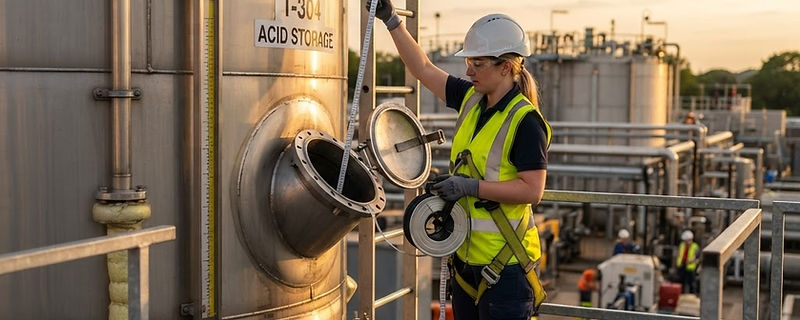
Nominal or working volume?
A 10,000 litre tank rarely holds 10,000 litres of usable liquid. Freeboard, inlet height, outlet height and dead storage all reduce the working volume. For process design, always state which figure you are quoting.
Vertical cylindrical tanks
V = π × D² / 4 × H
With inside dimensions in metres the answer is in cubic metres; multiply by 1000 for litres. A 2.0 m diameter, 2.5 m high tank holds 7.85 m³, about 7,850 litres.
Allowing 10% freeboard, the working volume is roughly 7,070 litres. For a fire water or potable supply, confirm the freeboard requirement with the relevant standard before committing.
Rectangular tanks
Volume is simply length × width × height. Rectangular tanks are common in transport and in tight plant rooms because they use the available footprint efficiently, but they need internal baffles on moving vehicles.
Horizontal cylinders
A horizontal tank is the awkward one, because the level gauge reads depth and the volume does not change linearly with depth. The liquid surface forms a circular segment:
A = R² cos⁻¹((R − h)/R) − (R − h)√(2Rh − h²)
V = A × L
At 50% depth the tank is half full, but at 25% depth it holds only about 19.6% of capacity. This non-linearity is why dip charts exist and why a straight linear interpolation on a fuel tank is always wrong.
Cone bottom tanks
Cone bottom tanks are used where complete drainage matters — slurries, powders, food and pharma. The volume is the shell plus the cone:
V(total) = π D² H / 4 + π D² h(cone) / 12
The cone holds a surprisingly small proportion of the total but carries the full hydrostatic head at the outlet, so structural support and outlet reinforcement need attention.
Converting to mass
Water is 1 kg per litre, so a cubic metre is one tonne. That mass acts on the floor and the supporting structure, and it is usually the governing load case for a tank stand. Slurries and chemicals should be calculated from actual specific gravity.
Run the numbers with the Tank Volume Calculator or the Horizontal Tank Partial Volume Calculator.