

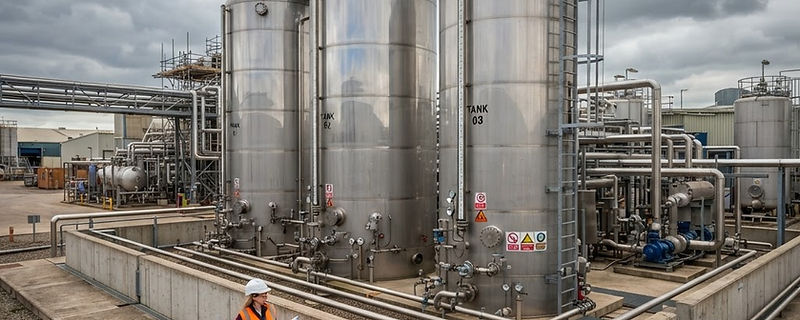
Determining the capacity of an industrial storage vessel requires an appreciation of precise geometric measurement and unit conversion. In professional engineering practice, volume is typically derived from the internal dimensions of the shell and head configurations, ensuring that all measurements are consistent prior to conversion. The transition from cubic metres to a liquid capacity measurement in litres is defined by the fundamental relationship where one cubic metre equals 1,000 litres. ## Geometric Fundamentals The calculation of tank volume in litres is predicated on the specific shape of the container. For vertical or horizontal cylindrical vessels, the primary calculation involves the cross-sectional area of the cylinder multiplied by its length or height. When dealing with rectangular tanks, the product of the length, width, and depth (internal dimensions) provides the volume in cubic metres, which is then multiplied by 1,000 to determine the capacity in litres. When accounting for vessel heads—such as torispherical, hemispherical, or elliptical ends—the additional volume must be included in the total capacity summation. Practitioners often use vessel shell equations guided by AS 1210 or AS 1692 when designing pressure or atmospheric storage vessels, as these standards specify how material thickness and weld details influence internal geometry. ## Worked example This example calculates the total capacity of a vertical cylindrical tank with flat ends. 1. Determine internal diameter (D): 2,400 mm (2.4 metres). 2. Determine internal height (H): 4,000 mm (4.0 metres). 3. Calculate cross-sectional area (A) using the formula A = π × (D/2)^2: A = 3.14159 × (1.2 metres)^2 = 4.5239 square metres. 4. Calculate total volume (V) in cubic metres: V = A × H = 4.5239 square metres × 4.0 metres = 18.0956 cubic metres. 5. Convert to litres: 18.0956 cubic metres × 1,000 = 18,095.6 litres. The total nominal capacity of the vessel is 18,096 litres. ## Common mistakes When performing these calculations, several recurring errors can impact the accuracy of the result: 1. Neglecting internal versus external dimensions: Always ensure calculations are based on the internal wetted dimensions, particularly for heavy-walled vessels where the shell thickness represents a significant percentage of the total diameter. 2. Misalignment of units: Converting metres to millimetres after the volumetric calculation is a common source of order-of-magnitude errors; maintain consistency in metres (SI) throughout the calculation process. 3. Overlooking head volume: Simply calculating the cylinder volume often leads to underestimating the capacity for tanks with dished, conical, or hemispherical heads. 4. Rounding too early: Retaining precision through intermediate steps is essential, particularly when calculating partial volumes or dealing with complex geometric assemblies.
tank volume in litresvessel designfluid dynamicsgeometryindustrial storagemetrology